How to Track Local Keywords Without Inaccurate Map Data Getting in the Way
How to Track Local Keywords Without Inaccurate Map Data Getting in the Way
I. Introduction: The “Ghost Ranking” Problem
Imagine this: You are a local business owner, perhaps a personal injury lawyer or a high-end HVAC contractor. You sit down at your office desk, open your laptop, and type your primary service into Google. To your delight, your business appears at the very top of the Local 3-Pack. You feel a sense of accomplishment, believing your google business profile seo is firing on all cylinders. However, the phone isn’t ringing. Why?
The answer lies in the “Proximity Trap.” Because you are searching from your own office, Google’s algorithm – which prioritizes Distance as a primary ranking factor – is giving you a biased result. You are #1 at your desk, but you might be invisible three miles away at a busy intersection where your actual customers are searching. This phenomenon is what we call “Ranking Blindness.”
Google’s core local ranking factors are built on three pillars: Relevance, Distance, and Prominence. While you can control relevance through content and prominence through backlinks, distance is the “silent killer” of local SEO accuracy. If you aren’t tracking your rankings across a geographic spread, you are essentially flying blind. This is exactly Why Your Google Business Profile Strategy Is Getting Zero Phone Calls; you are optimizing for a single point on a map rather than a service area.
II. Why Traditional Rank Tracking Fails Local Businesses
For years, SEO professionals relied on traditional rank trackers that provided a “city-level” or “zip-code level” ranking. In the world of organic desktop search, this was sufficient. However, the Google Maps interface is hyper-local. The results displayed to a user can change drastically every few blocks. A “zip code” is far too large a geographic area to provide an accurate representation of your visibility.
Traditional trackers often use a single “centroid” or a fixed IP location to ping Google. This results in a single number – say, “Rank #3” – which is then averaged over time. This data is not only incomplete; it is dangerously misleading. If you rank #1 in a 1-mile radius but #20 everywhere else, an “average rank” might tell you that you are doing fine, while your business is actually losing 90% of its potential local market share.
To solve this, modern marketers are turning to advanced google maps seo tools that allow for coordinate-based tracking. By moving away from static city-level data, you can begin to see the “Proximity Wall” – the exact point where your business stops appearing in the top results and your competitors take over.
III. The Solution: Geo-Grid Tracking & Heatmaps
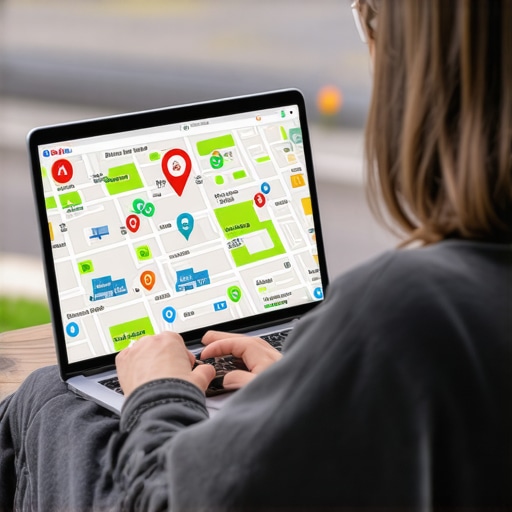
The evolution of the google maps rank tracker has led us to Geo-Grid tracking, also known as grid-map tracking or heatmap analysis. Instead of checking a single location, a geo-grid tool places a series of “pins” across a map at specific GPS coordinates. For each pin, the tool simulates a search and records where your Google Business Profile (GBP) ranks for a specific keyword.
The result is a visual heatmap. Pins are typically color-coded: green for ranks 1-3 (the Map Pack), yellow for ranks 4-10, and red for anything lower. This visualization immediately reveals your “blind spots.” You might find that you dominate the northern part of your city but are completely blocked out in the south by a competitor with more reviews or better-optimized local citations.
Using tools like SEO Viper Tools or Local Falcon allows you to visualize this data in a 3×3, 7×7, or even 15×15 grid. For most local service businesses, a 7×7 grid is the “sweet spot.” It provides enough granularity to see neighborhood-level shifts without being overwhelmed by data noise. This visual evidence is crucial for any Exact Maps SEO List We Use to Dominate Proximity Searches, as it dictates exactly where you need to focus your local content and link-building efforts.
IV. How to Set Up a Pro-Level Local Keyword Audit
Setting up an accurate tracking system requires more than just entering a URL. To get a true picture of your local map pack seo, follow this step-by-step guide:
1. Identifying Core Keywords
Don’t just track your brand name. You need to track “Service + City” and “Service Near Me” keywords. For example, a dentist in Dallas should track “Invisalign Dallas,” “Emergency Dentist Dallas,” and “Teeth Whitening near me.” These are the high-intent keywords that drive revenue.
2. Setting the Grid Radius
The radius of your grid should match the reality of your industry. A coffee shop might only care about a 2km radius, as people rarely drive across town for a latte. A specialized surgeon or a luxury car dealership, however, might set a 20km radius because customers are willing to travel for those services. Setting the wrong radius will result in “Red Zones” that you can never realistically turn green.
3. Analyzing the “Red Zones”
Once the grid is run, look for patterns. Is there a specific competitor who always beats you in the “Red Zones”? Use a google business profile audit tool to analyze their profile. Do they have more google business profile reviews? Is their primary category different? Do they mention the specific neighborhood in their website’s meta descriptions?
By identifying why certain areas are failing, you can move away from guesswork. This is the foundation of How to Run a Pro-Level Google Maps Audit Without Expensive Tools – it’s about the strategic application of data, not just the cost of the software.
V. Overcoming the “Proximity Wall”
Once you have identified your ranking boundaries through a google maps rank tracker, the next step is to expand your “circle of influence.” While you cannot change your physical distance from a searcher, you can increase your **Prominence** and **Relevance** to convince Google that you are the best result even if you aren’t the closest.
- Google Business Profile Optimization: Ensure your profile is 100% complete. Use high-resolution photos, post weekly updates, and answer every Q&A.
- Hyper-Local Content: Create pages on your website dedicated to specific neighborhoods within your city. Mention local landmarks, parks, and community events.
- Localized Link Building: General SEO backlinks are fine, but local SEO thrives on local relevance. This is Why Niche Citations Beat Generic Directory Listings Every Single Time; a link from a local chamber of commerce or a neighborhood blog carries more weight in the Map Pack than a generic directory listing.
- Review Velocity and Sentiment: It’s not just about the total number of reviews. Google looks at how frequently you get reviews and if the text of those reviews mentions your services and locations.
Data from recent industry studies suggests that manual searching is heavily biased by your personal search history and physical location. Therefore, relying on third-party geo-grid data is the only objective way to measure the success of your rank google business profile efforts.
VI. Future-Proofing for 2026: AI & Experience Signals
As we look toward 2026, the local seo checklist 2025 is already evolving. Google is increasingly using AI (Search Generative Experience or SGE) to pull data directly from your GBP posts and customer reviews to answer complex queries. If a user searches for “plumber who can fix old Victorian pipes,” Google’s AI will scan your reviews to see if any customers have mentioned “Victorian pipes.”
These “Experience Signals” are becoming a massive ranking factor. To stay ahead, you must ensure your google business profile optimization includes a strategy for generating detailed, keyword-rich reviews. Furthermore, AI-driven search is making proximity even more nuanced; Google may prioritize a business further away if the AI determines that business has a higher “Experience Score” for a specific niche request.
Keep your strategy sharp by following the 3 New 2026 Local Updates That Fix Your Maps SEO List Fast to ensure your tracking and optimization remain relevant in an AI-first search environment.
VII. Conclusion & CTA
In the competitive landscape of local search, “average” data is equivalent to no data at all. If you are still relying on old-school rank trackers, you are missing the hyper-local shifts that determine whether or not your business actually gets found by customers. Accurate tracking through geo-grids is the only way to see the “Proximity Wall” and develop a plan to break through it.
Stop guessing about your visibility. If you want to see exactly where you stand and how to dominate your local market, it is time to invest in a professional google maps ranking service. By using high-precision local seo tools, you can turn your “Red Zones” into “Green Zones” and ensure that when customers in your city search for your services, your business is the one they find first. Audit your profile today and reclaim your local rankings.